Miriam Nzululwazi falls to her death from the intelligence building
Heart of the HunterMiriam Nzululwazi falls to her death from the intelligence building after leaving a Presidential Intelligence Unit interview room without an escort. Her death turns a procedural failure into an irreversible human consequence: Vincent Radebe later admits that he left the door unlocked and that her fatal fall followed directly from her departure while in a disturbed state of mind. The account also places the tragedy within a longer history of state custody and fear, and makes Radebe’s inquiry testimony a record of both responsibility and institutional harm.
Circumstances and Earlier Fear
The death is first disclosed in a conversation between Allison Healy and Zatopek van Heerden. Allison insists that the news concerns Miriam, not their relationship, and tells him that Miriam died the previous night. The authorities, she says, will describe the fall only as an accident: Miriam fell five storeys. The news leaves Van Heerden silent and shaken. At this point, the conversation gives the outcome but not the full chain of events that produced it; the later inquiry supplies that account.
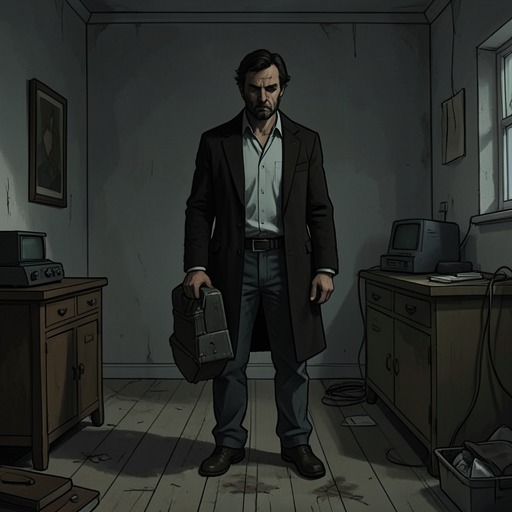
The interview room gives the episode a significant institutional setting. During its design, Janina Mentz questioned the assumption that interrogation required a table, hard chairs, bare walls, and an uncomfortable atmosphere. She insisted that the Presidential Intelligence Unit was not a police station and had three easy, brown, stain-resistant chairs installed instead. They were bolted to the floor in an intimate triangle, while a concealed microphone and a camera behind one-way glass preserved the room’s surveillance function. That more humane design does not make the interview safe: the door is not locked, and Miriam is ultimately left to leave without an escort. The contrast is between considered surroundings and a failure of care at the threshold.
Miriam’s fear in that room has a history. Fifteen years earlier, at seventeen, she had been caught in a demonstration and taken to the cells at Caledon Plain. The protest, which had blocked the road, broke apart in a police charge; she was pushed into a crowded cell where a woman screamed for her sick child as a policeman raised and repeatedly brought down his truncheon. Miriam remembered gripping the arms of her chair in the interview room, while her eyes seemed unable to register the wall before her. The narrative links the present interrogation to that remembered terror without claiming that the earlier event alone explains her later fall. It establishes that detention is not a neutral setting for her: the room brings an old fear into the present.
The Fall and Its Immediate Meaning
The clearest account of how Miriam died comes from the inquiry transcript dated 7 November. Vincent Radebe admits that he neglected to lock the interview-room door. As a direct result, Miriam left the room without an escort and in a disturbed state of mind; she then fell to her death from the building’s fire escape. The statement identifies a specific breach, a specific consequence, and the fatal outcome. It does not present the fall as an intentional act, nor does it establish an alternative account to the official description of an accident.
That procedural detail changes the meaning of the brief news Allison gives Van Heerden. The five-storey fall is not merely an unexplained mishap occurring during an intelligence operation. Radebe’s admission connects it to a preventable lapse while Miriam was in the unit’s care. His words make the unlocked door consequential: once she could leave without supervision, her disturbed condition became part of the circumstances leading to the fatal fall. The inquiry records his responsibility in the language of negligence rather than claiming that he intended her death.
Inquiry and Wider Breaches
The Commission of Inquiry into the death of Mrs Miriam Nzululwazi, held on 7 November, was chaired by Advocate B. O. Ndlovu, with Advocate P. du T. Mostert and K. J. Mapoyane as assessors. Janina Mentz appeared for the Presidential Intelligence Unit. No witnesses were called. The account of the death therefore enters this record through Radebe’s written admission, rather than through a succession of witness testimonies.
Radebe accepts responsibility not only for the unlocked door and Miriam’s death, but also for abducting her six-year-old son, Pakamile, without official sanction. He admits keeping the boy at his home overnight and handing him to personnel of the Cape Times the following day, thereby undermining the unit’s operation. He declares that he acted alone in both matters and does not seek to implicate anyone else. These admissions widen the inquiry’s significance: the episode involves a fatal failure in custody, the unlawful removal of a child, and an unauthorized handover to the press. They are distinct actions, but together they show how far the operation had departed from lawful and accountable conduct.
In his statement, Radebe acknowledges that protecting the state and democracy can involve difficult decisions that negatively affect innocent civilians. He then says that he is unsuited to intelligence work and was never suited to it. The events of 26, 27, and 28 October, he explains, were traumatic, particularly because he believed the basic human rights of Thobela Mpayipheli and then Miriam had been infringed. He cannot understand how the operation’s importance to national security justified its means. His regret is specific: he says that dismay clouded his judgment, that he was negligent when he should have been diligent, and that he failed to protest more forcefully through official channels. He identifies his greatest weakness as doubting his own judgment of right and wrong.
Consequence and Narrative Significance
Miriam’s death makes the consequences of intelligence work visible in a record usually organized around state protection and operational necessity. Radebe’s testimony does not erase his part in the events; it formally acknowledges that his omission directly preceded her fatal fall. Nor does the statement turn his remorse into a substitute for accountability. Instead, the inquiry preserves the sequence of negligence, unescorted departure, and death alongside his admissions about Pakamile and the rights violations he believed had occurred.
The narrative also places Miriam’s earlier experience of police custody beside her final time in an intelligence building. The former returns through memory: a crowded cell, a child’s desperate cry, and the threat of a truncheon. In the later room, her hands grip the chair as the past intrudes on the present. The text does not collapse the two episodes into one, but their juxtaposition gives her final detention a history that the formal account of an accident cannot contain. Her death is therefore both a specific consequence of Radebe’s admitted negligence and the culmination of a story in which official custody has already been associated with fear and the violation of ordinary protections.